Partner Story · in conversation with the developer of Ankita. This is a written interview submitted through Submit Your Story and is about the product only. The claims below are the project's own, presented as they were given to us. No payment was involved.
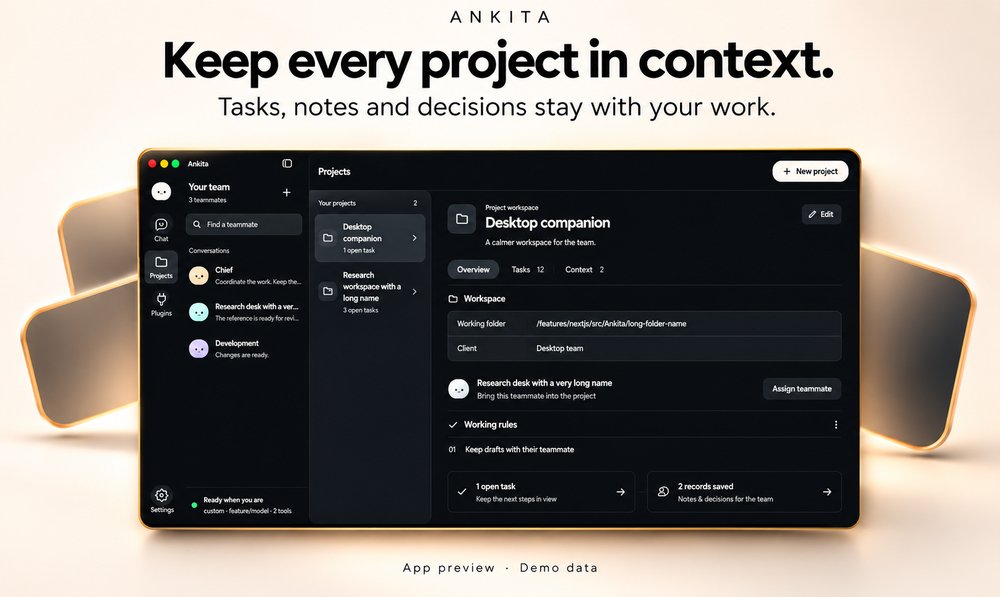
The Projects workspace in Ankita. App preview with demo data. Image: Ankita.
Most people who use AI at work know the routine. Open a chat tab, describe the job, copy the answer out, paste it somewhere else, and then do the actual work yourself. The model was smart enough. The work still went through your hands.
Ankita is built for the other half of that job. It is a free, open-source AI companion that runs in the background on a Windows computer. You say a request once, and it opens the app, sets up the workspace or runs the job, then tells you when it is done.
"The models are good enough to do the work," the project says. "The missing piece is a companion on the desktop that can be trusted to act, with clear limits on what it may do unsupervised."
No API key, no extra bill
The first thing that sets Ankita apart is what it does not ask for: money.
A fresh install starts on Kilo's free models, which need no key. Ankita can also chat through a ChatGPT tab the user already has open, so a person who already pays for ChatGPT does not need a separate API account and a second bill on top. Providers can be switched in Settings, and there is an opt-in DeepSeek provider running on Modal for people who want it.
For a small team or a freelancer, that matters. Many desktop agents assume a paid API key, and the cost per task grows with every job the agent runs. Ankita's default setup costs nothing beyond what the user may already be paying.
The app itself is free, and the code is public on GitHub under the MIT license.
How a job runs
Ankita is a desktop app for 64-bit Windows, built on Electron. Behind the scenes it follows a simple loop: plan with a model, carry out the plan through skills and plugins, and report back.
Voice is built in. After an answer, Ankita keeps listening for 25 seconds, so a follow-up does not need a wake word, and saying stop or cancel interrupts a reply. Long jobs get spoken progress updates and a completion report, and each job is tracked by its own ID.
Skills and plugins are how Ankita reaches the rest of the computer. An app launcher opens installed apps by name. Plugins can include MCP servers, the standard way many AI tools now connect to outside services. The personality is editable in Settings.
There is also a way to keep going from a phone. A desktop job can be continued from the phone's browser after pairing with a code that expires in two minutes. Only four files are allowed through that channel, and nothing has to be installed on the phone.
Approval first, undo always
The second difference is the one the project cares about most: Ankita is designed to be safe to leave running.
Every action sits behind approval gates with four tiers, and the check runs on every click. Destructive actions can be undone. "Safe to leave running, not just clever in a demo" is how the project describes the goal.
That is a practical point for anyone thinking about letting an AI touch real files. An agent that deletes the wrong folder once costs more time than it saved all month. An agent that asks first and can roll back is one a person can actually delegate to.
A memory that argues back
The third idea is memory. Most assistants save what they are told and quietly overwrite older facts. Ankita stops saving near-duplicates, and when a new fact contradicts an old one, it flags the contradiction instead of replacing it.
The point is that what the companion remembers stays honest. A wrong fact that slips in silently can steer every later answer. A contradiction that is flagged gets checked by a person.
What has shipped
Ankita has shipped in small, frequent releases, and the history is public on GitHub. Version 2.7.5, released on November 1, 2026, added the voice mode that keeps listening, the app launcher, the editable personality and phone continuity with a pairing code.
Recent merged work includes two-way messaging between sub-agents and a new skill discovery step that cut the number of calls needed to find a skill from 39 to 21. Fewer calls means faster answers and, on paid providers, a smaller bill.
The project is open in practice, not just in name. The code, skills and plugin system are public, and the first skill built by the community, a guided tour of a codebase, was merged from an outside contributor. Ankita is listed on two "awesome AI agents" lists, and the third-party index XERJ Corpus Hub selected one of its security fixes for inclusion.
The lesson: the gate must never be skippable
The sharpest lesson came from that security fix.
Someone found a way around the phone approval gate: a path that would have let an action through without the check it was supposed to pass. The quick fix would have been to close that one path. The project chose to treat the gate itself as the one thing that must never be skippable, whatever channel a request comes from.
That became the design rule for every new channel Ankita adds. "The check comes first, the convenience second."
It is a rule worth borrowing for any company putting an AI agent near its systems. Every new way to reach the agent, a phone, a chat app, a scheduled job, is a new way around its limits unless the limits are built in first.
What's next
The next features are planned, not shipped. Each scheduled job will be able to choose how it reports back: spoken, by Telegram, in the app's floating island, or silently in a log. Long-running skills will stream their output, so a slow job shows progress instead of looking frozen. And a troubleshooter will walk from a symptom described in plain words to the exact fix.
The request from the project is simple: try it, and say what broke. Ankita is free to download at ankita-sable.vercel.app, and the source code and issue tracker are on GitHub.
---
This is a Partner Story: a written interview about a product built with AI, submitted through Submit Your Story and published free of charge. Statements about the product, its users and results are the project's own. Building something with AI? Tell us about it.
Would you try this product?