Partner Story · in conversation with Bogdan Duțescu, founder of qodiqa. This is a written interview submitted through Submit Your Story. The claims below are the founder's own, presented as they were given to us. No payment was involved.
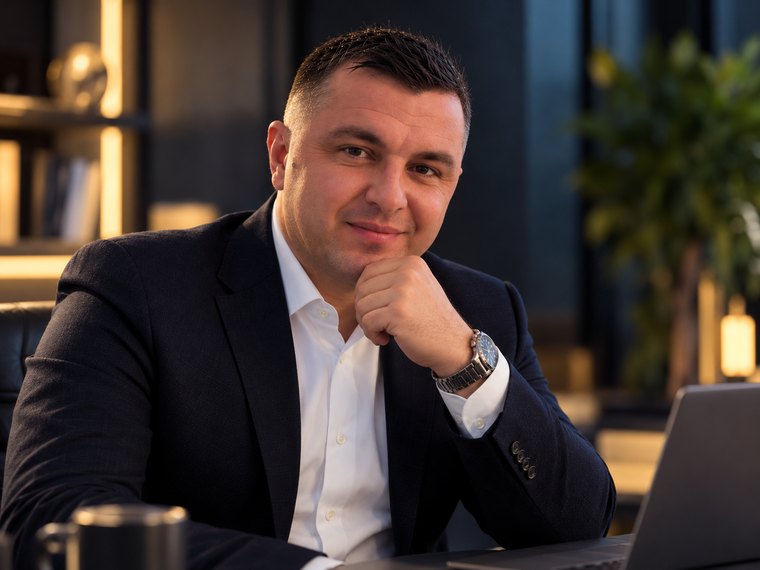
Bogdan Duțescu, founder of qodiqa, Romania. Photo supplied by Bogdan Duțescu.
Picture an AI agent acting on a customer's behalf. Who authorised it? For what purpose, within which limits, for how long? And afterwards, can anyone prove it stayed within those limits?
"A checkbox cannot answer any of that," says Bogdan Duțescu.
For years, Duțescu says, the industry has treated digital consent as a yes or a no. qodiqa, the open-source project Duțescu founded in Romania, is built for what happens once AI starts acting on that yes. It sits between a company's applications and its AI providers, checks who authorised an action, applies the company's rules, and produces evidence of what actually ran.
The problem: controls that have barely moved
AI has become more capable and more autonomous, and in Duțescu's view the controls around it have not kept up. Most systems still rely on static permissions, instructions inside a prompt, content filters or a consent box. Most also record what an AI did only after it has done it.
The need grows, Duțescu argues, with every agent that starts to decide and act on its own. If an agent spends money, reads a customer's file or sends a message, the company behind it will eventually be asked who allowed that, and it will want a better answer than a line in a policy document.
How it works: no consent, no call
qodiqa puts one checkpoint in front of the AI provider.
A request has to arrive with a signed permission. That permission lasts at most 60 seconds, can be used only once and is tied to that exact request, so it cannot be reused for a different one. The gateway checks the signature, then runs the company's rules. The outcome is one of two words: EXECUTE or BLOCK.
The example on the company's site is an ordinary one: an application asks a model to summarize a customer's order history for a support agent. If that customer's consent has been withdrawn, the request stops there and the provider is never called. A refused request reaches no model, so it also costs nothing to run. And if the checks themselves fail, the system fails closed: no valid consent, no call.
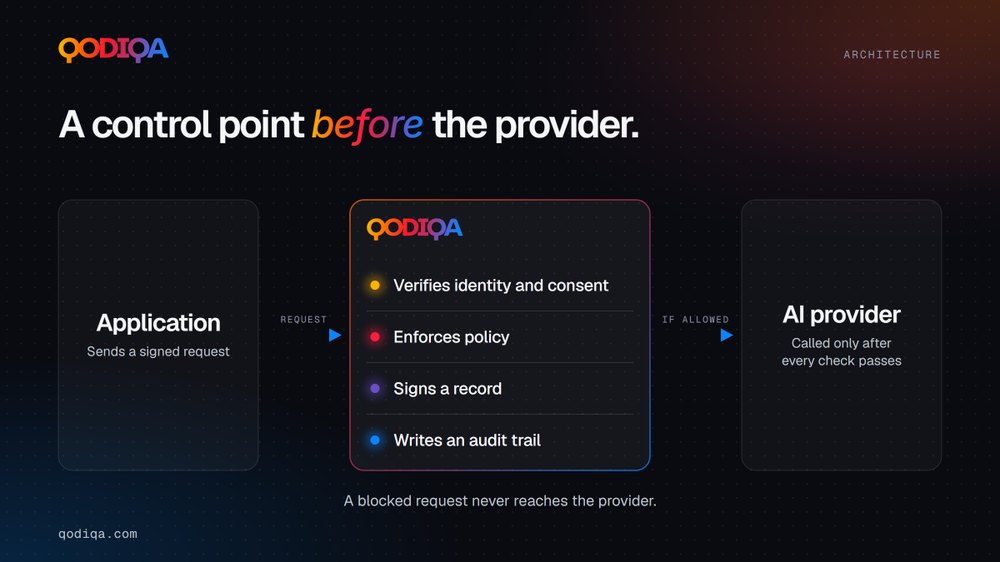
qodiqa sits between the application and the AI provider. Image: qodiqa.
Every decision, allowed or refused, becomes a signed receipt in a chain where each entry depends on the one before it, so changing history breaks every link after it. Anyone can check a receipt offline with an open-source verifier, without an account and without qodiqa's servers. You can watch one request go through the steps in a simulation on the site.
"You don't have to trust us," Duțescu says of the part that makes the founder proudest. "That is what 'accountable AI' should mean: not a promise, but evidence a stranger can verify."
Where the AI sits
AI is how qodiqa understands what is being asked. A semantic policy engine, with specialised classifiers and a confidence score, analyses an interaction and looks for its intent and for possible policy violations.
The design choice that matters is what happens next. qodiqa does not simply ask another model whether something is safe. "Semantic analysis informs the decision, deterministic rules make it," Duțescu says, and the outcome is recorded as a signed artifact.
Behind that is one principle: AI systems should not be responsible for governing their own execution. Model-level safeguards are useful, Duțescu says, but they live inside the thing being governed.
Built to fit what companies already run
qodiqa is meant to sit alongside existing infrastructure. The open-source gateway includes integrations for model providers such as OpenAI, Anthropic, Google Gemini and Mistral AI, and for local models through Ollama. It also connects to enterprise sign-in systems, key management services, and monitoring tools such as Datadog and Splunk.
The whole system is public: the gateway, an independent verifier and a set of anchors for audit checkpoints, in three repositories under the Apache 2.0 license, plus a 32-document specification under CC BY 4.0. Developers can start a local sandbox with one Docker command.
The lesson: the hard part was not the AI
Integrating models turned out to be the easier job. The hardest part, Duțescu says, was designing a system where semantic intelligence, deterministic rules and verifiable evidence work together without depending on any single AI provider.
That is why the team chose to build an independent layer instead of another AI safety filter, and to do it open from the ground up. "That decision became the foundation of qodiqa."
Where it stands today
Duțescu is direct about the stage. "No customers yet, no external certification." The decision was to publish the whole system first and let it be scrutinised. The project's documentation also says that adapters for hosted providers and the production Kubernetes setup have not yet been validated against real services, and that semantic screening is optional and needs models supplied separately.
What comes next
The immediate goal is to bring qodiqa into real-world environments. Duțescu is looking for early design partners, technical collaborators and independent reviewers: teams deploying enterprise AI and agents, AI infrastructure providers, cybersecurity and AI governance organisations, and security researchers willing to test it against real use cases.
Longer term, Duțescu believes verifiable consent, enforceable execution policies and cryptographic evidence will become a standard part of the infrastructure for responsible AI adoption. The code, specification and simulation are at qodiqa.com.
---
This is a Partner Story: a written interview with a founder building with AI, submitted through Submit Your Story and published free of charge. Statements about the company's product, users and results are its own. Building something with AI? Tell us about it.
Would you try this product?