Partner Story · in conversation with Hadungwra Brahma, founder of Larkgrass. This is a written interview submitted through Submit Your Story. The claims below are the founder's own, presented as they were given to us. No payment was involved.

Hadungwra Brahma, founder of Larkgrass, Kokrajhar, Assam, India. Photo supplied by Hadungwra Brahma.
A bakery owner keeps her orders in a simple tracker. Every Monday at 8, an AI agent sends her last week's orders and a list of who still has to pay. It drafts a friendly reminder for each unpaid order, and then it waits. She reads them, taps Approve, and only then do they go out.
That is the kind of job Larkgrass was built for. Its founder, Hadungwra Brahma, is a software engineer with an MCA from Bodoland University who built the product alone in Kokrajhar, Assam, India. Larkgrass gives people a team of AI agents that do everyday computer work and check with them before anything is sent, bought or deleted.
The hours that disappear into small jobs
People who run a small shop or freelance, Brahma says, lose hours every week to small computer jobs: chasing unpaid orders, answering the same customer questions, keeping the calendar straight. None of it is hard. All of it eats the week.
AI agents can now handle a lot of this. The catch is who the tools are built for. "Most agent tools are built for developers and expect you to write prompts, connect APIs or read logs," Brahma says. "Larkgrass is for people who want to say what needs doing in plain words."
How it works: a crew, hired in one click
Every account starts with one agent, a "Chief of Staff." You describe your kind of work, and it suggests a crew, such as a bookkeeper, a support agent, a social media helper or a researcher. You hire them in one click and name them whatever you like.
Under the hood, each agent is an AI model with its own Linux computer, with a browser, files and a terminal, plus its own memory, scheduled routines, and connections to apps like Gmail, Google Calendar, Slack, Notion and Stripe. Each turn runs as a LangGraph graph: check the request, think, act, repeat. Apps plug in through MCP, the open standard for connecting tools to AI models.
Because the agents work on a real computer, they can open a website, fill in a spreadsheet or download a file while you watch. You can take over the mouse or press Stop at any point. You can also teach an agent a new task by doing it once in its browser.
Approval is the design, not an add-on
Tools that only read run straight away. Anything that changes something goes through the user's approval settings. You choose which actions need your OK, such as sending email, spending money, deleting or posting. Before the agent acts, you get a card with three buttons: Approve, Always allow or Deny.
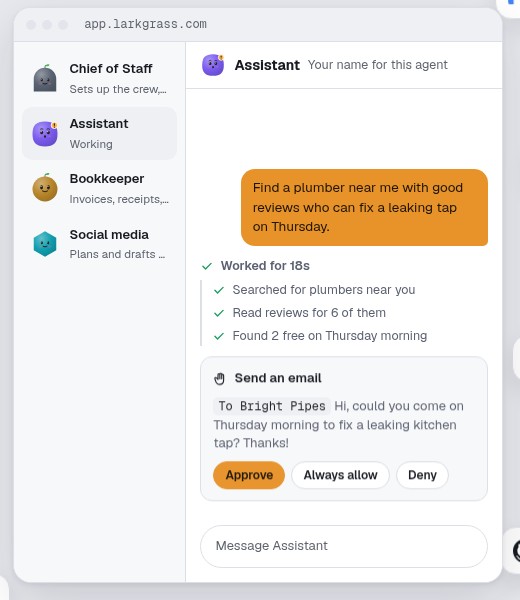
An agent searches for plumbers, reads reviews, finds two free on Thursday morning, and stops for approval before it sends the email. Screenshot supplied by Larkgrass.
This was the hardest decision in the whole build, Brahma says: how much freedom to give the agents. The answer came early. "I decided early that nothing gets sent, bought or deleted without the person's OK. I don't think people will hand real work to an assistant they can't check."
What it costs, and how it stays cheap
A small, fast model reads each request first and sorts it as a light, medium or heavy job. Simple tasks stay quick and cheap, and harder ones go to a stronger model. The free tier runs on open models such as DeepSeek and GLM. People can also bring their own key from seven AI providers or run a local model.
On the pricing page, the first job is free with no card. After that, the first week costs $5, and the Starter plan is $25 a month, with bigger plans for heavier use. Each plan has a weekly usage limit shown as a bar, and unused allowance carries over to the next week. Usage on your own AI account does not count toward the limit.
Where it stands today
Brahma is plain about it. "It's very early. Larkgrass opened to the public at the end of October 2026, and the first users signed up that same week. I'd rather not dress the numbers up."
For now, the focus is on getting real small businesses to use it and learning from what they ask it to do.
The lesson: one crew instead of one fix
A few weeks before the launch, Brahma was building something else: a service that fixed Google Shopping feeds for online stores. Brahma dropped it to work only on Larkgrass.
The reasoning was simple. The feed service fixed one of the small jobs that fill a shop owner's week. A team of agents could take on most of them.
What comes next
Next up are phone apps and a simpler first setup for people who have never used an AI agent.
Brahma is looking for early users, mainly small business owners and freelancers, who will try it and say honestly what is missing. Anyone can try it free at larkgrass.com.
---
This is a Partner Story: a written interview with a founder building with AI, submitted through Submit Your Story and published free of charge. Statements about the company's product, users and pricing are its own. Building something with AI? Tell us about it.
Would you try this product?