Partner Story · in conversation with Tan Liyuan of Whispart Studio. This is a written interview submitted through Submit Your Story. The claims below are his own, presented as they were given to us. No payment was involved.
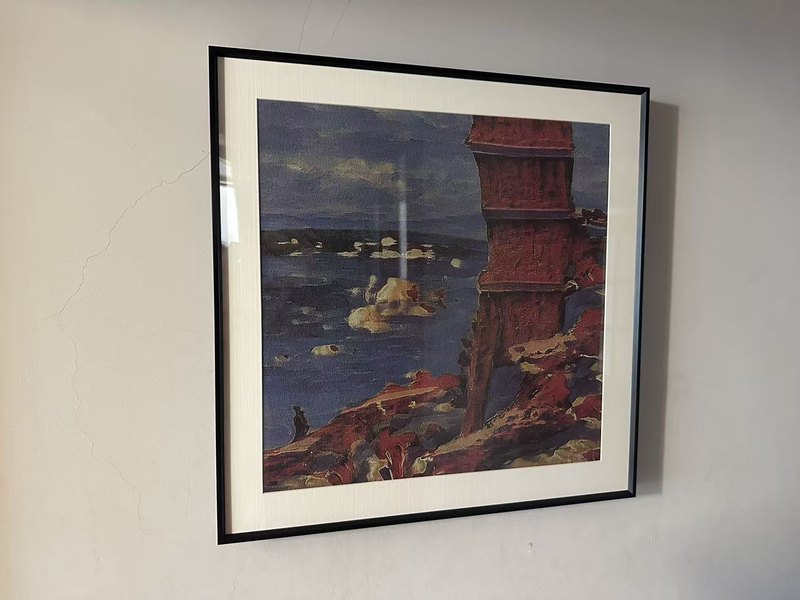
Without Echo, the finished framed work, photographed on a wall. Artwork and photograph: Whispart Studio.
There is a moment every seller of AI images eventually reaches. The pictures are good. They sell. And then one morning you scroll through the marketplace and cannot tell your own work from the listing beside it.
Tan Liyuan reached that moment on Walmart and Amazon.
For about two years, he and his collaborators sold AI-generated decorative canvas prints through the big marketplaces, thousands of them, as he told the art magazine QEditorial earlier this month. The business worked. But the images were becoming interchangeable, other sellers were producing the same kind of thing, prices were falling, and a customer who liked a picture on the wall had no reason to remember who had made it.
So they closed the stores.
What they built instead is Whispart, a three-person studio based in Kunming, in south-west China. It still makes pictures with a machine. It just refuses to make any of them twice.
The cheapest picture and the most expensive one
The turn came, Tan says, from a conversation with a friend about two prices.
One was the price he knew from the inside: an AI print sold in volume, worth a little less every month. The other was $432,500, the sum Christie's achieved in 2018 for Portrait of Edmond Belamy, a portrait produced by a GAN. Neither number could say what a particular image meant to the person looking at it. But the distance between them made Tan ask what kind of company he actually wanted to run.
His answer sits between the two. Not a mass print, and not an auction lot. A single framed work, chosen with care, made well enough to live in an ordinary room, and priced like it. On the studio's site today, finished works are listed at $238 to $338, framed, with delivery to the United States.
A model of their own
The first thing Whispart changed was the machine itself.
"Our current collection comes from a GAN model we trained, which we call Mnemosyne," Tan says. The technical record behind it is a StyleGAN2-ADA training workflow. There is no text prompt describing each scene. The team chooses the source material, trains the model, compares what different stages of training produce, and then searches through the outputs. Each image begins from sampled numbers, not from a sentence.
The studio describes this, in its own published account of the process, as a controlled accident. People set the boundaries: which paintings, landscapes and figure studies go into a training set, how they are cropped, which saved state of the model is worth exploring. Inside those boundaries, the model is free to produce compositions nobody asked for.
That freedom was the point. In their earlier prompt-led experiments, even randomised prompts began with words telling the image what to contain. Training their own model moved the human decisions to where Tan thinks they belong: before generation, in what the machine learns from, and after it, in what is kept.
"The model does not make the final selection," he says. "Technical progress in a run and our preference for an image are separate judgments."
One in fifty thousand
The economics of Whispart begin with a striking ratio. In one early period of experiments, Tan has said, more than 100,000 outputs yielded just two works the team chose to make physical.
That is the business model in miniature. A generator can produce images without end, so the images themselves are not scarce and never will be. What is scarce is the decision: this one, and not the others. Whispart has built its offer around making that decision visible and binding.
Every final image gets a title and a permanent archive number. The studio's release policy is one authorised physical edition of each image. Tan is careful about what that means. "That is an edition commitment, not a claim that a digital file cannot be copied." The buyer receives a certificate, and the work's page on the site becomes a record that it has been collected.
It is a quiet inversion of the marketplace years. Back then, the way to earn more was to sell the same picture again. Now the price of a work rests on the promise that it will never be sold again.
Honest about what the buyer gets
Tan's second preoccupation is a problem every online seller of art knows well: the picture on the screen is not the object that arrives.
A screen gives off light; a canvas reflects it. Texture, scale and the frame change what the eye notices. Whispart tested canvas, printing and suppliers before settling on a textured fine-art inkjet canvas at 50 by 50 centimetres, a size large enough to have presence and small enough not to expose the limits of the image detail. The works are printed and framed by a partner in Zhejiang, then checked and packed by a team member in Guangzhou.
And the studio labels its own pictures with unusual care. Generated images, real photographs of finished objects, and visualisations of a work in a room are marked as different things. "A pleasing room rendering cannot show a buyer the actual texture or finish of a physical work," Tan says. The photograph above is the real one: Without Echo, framed, on a wall.
For a market where many buyers suspect that AI images hide how they were made, that small discipline is part of the product.
The temptation to explain
The lesson Tan offers from building the studio comes from a single picture.
In The Crossing, parts of the image suggest figures, riders, perhaps distant structures. None of them settles into anything that can be named. The temptation, he says, was to explain the scene until it became recognisable.
"I found that doing so could remove the uncertainty that made me keep looking."
So he gave the work a title and left his own reading out of it. The same rule now runs through the business: be exact about the process and the physical object, and leave the image itself open. Explain the canvas, the frame, the model and the edition. Do not explain the picture.
Where the studio stands
Whispart is small and early, and Tan does not dress that up. The studio has a live shop with available works and published prices, a written account of how the GAN process works, and photographs of finished objects. He is not presenting revenue, customer-growth or funding figures for the studio in its current form.
"The evidence I can offer here concerns what we have made and made available, rather than a claim that the business has already succeeded at scale."
What comes next is more of the same, slowly: more selected works, clearer documentation of the choices behind each one, and conversations with readers, collectors and editors who would rather look closely at one specific work than argue about AI art in general.
There is something worth noticing in that. Many businesses built on generative AI are racing to produce more, faster and cheaper. Whispart learned on Walmart and Amazon where that race ends, and walked the other way. One of the studio's earliest framed pieces, Tan has said, now hangs in his mother's study. It is the test he still applies to every image: will it remain worth looking at in a real room, long after the novelty has gone?
Whispart's works are at whispart.com.
---
This is a Partner Story: a written interview with a company building with AI, submitted through Submit Your Story and published free of charge. Statements about the company's process, sales history and results are its own. Building something with AI? Tell us about it.
Would you try this product?