Partner Story · in conversation with Dejerae Trujillo of NVZN. This is a written interview submitted through Submit Your Story. The claims below are her own, presented as they were given to us. No payment was involved.
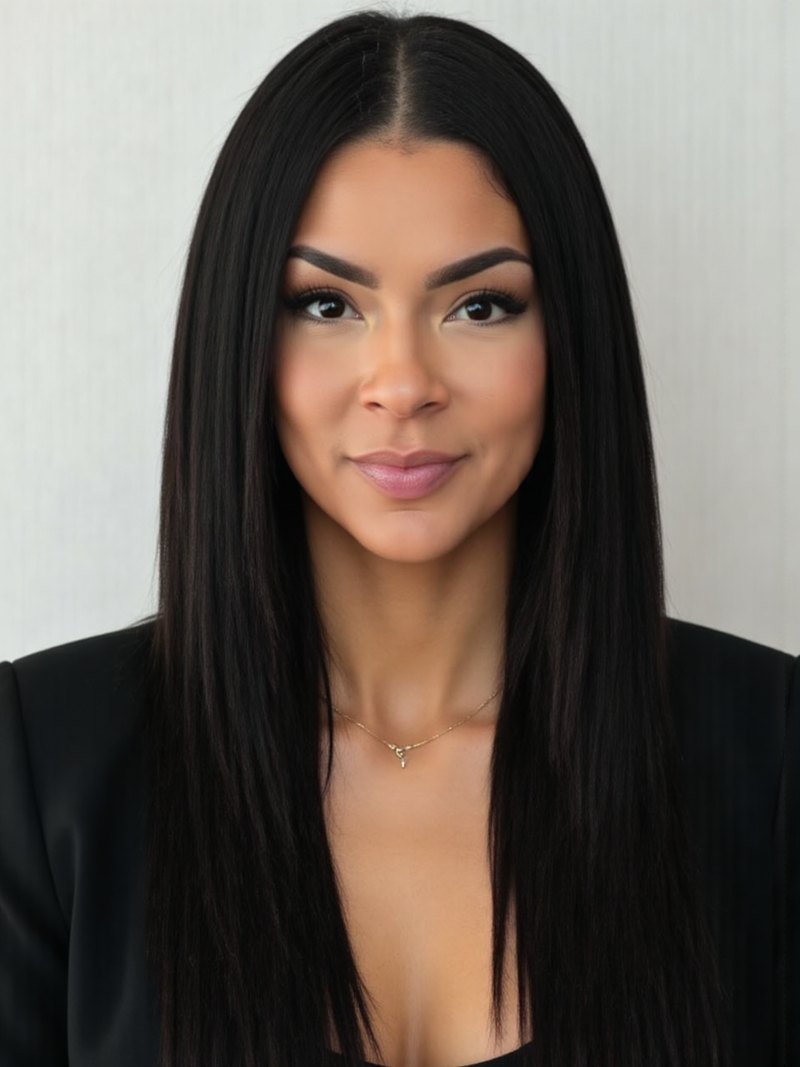
Dejerae Trujillo, founder and CEO of NVZN. Photo: Dejerae Trujillo / NVZN.
There is a size of business where the owner is still the router. Every quote, every invoice question, every supplier delay and every half-finished follow-up passes through one head. Hire someone and the bottleneck does not go away, it just gets a second seat.
Dejerae Trujillo built her company around that specific moment.
"Owner-operated shops of about 1 to 15 people often still have the founder as sales, marketing, admin, and follow-up," she says. "Burnout for these owners is not only long hours. It is being the permanent router across tools, inbox, and exceptions until they cannot even delegate."
NVZN, based in Denver, sells those businesses an AI Operations Dashboard: tasks, calendar, email, invoices and approvals in one place, with automations wired in behind them. The company says a build takes three weeks.
Twelve years of cleaning up other people's chaos
Trujillo is not a technologist who discovered small business. She is the other way round.
Before founding NVZN in July 2025, she spent twelve years in real estate, mostly at Compass and LIV Sotheby's, running her own businesses alongside it. What she kept being pulled into was never the transaction.
"It was taking messy situations and making them run: structure behind people, cleanup of chaos, and systems that held when I was the only adult in the room."
She is direct about where the instinct came from. As a single mother building a career while raising her son, systems were not a preference. "They were how the day held together. I had been automating my own life out of necessity long before it was a company."
What the product actually shows you
The demo is public, and it is the fastest way to understand the pitch.
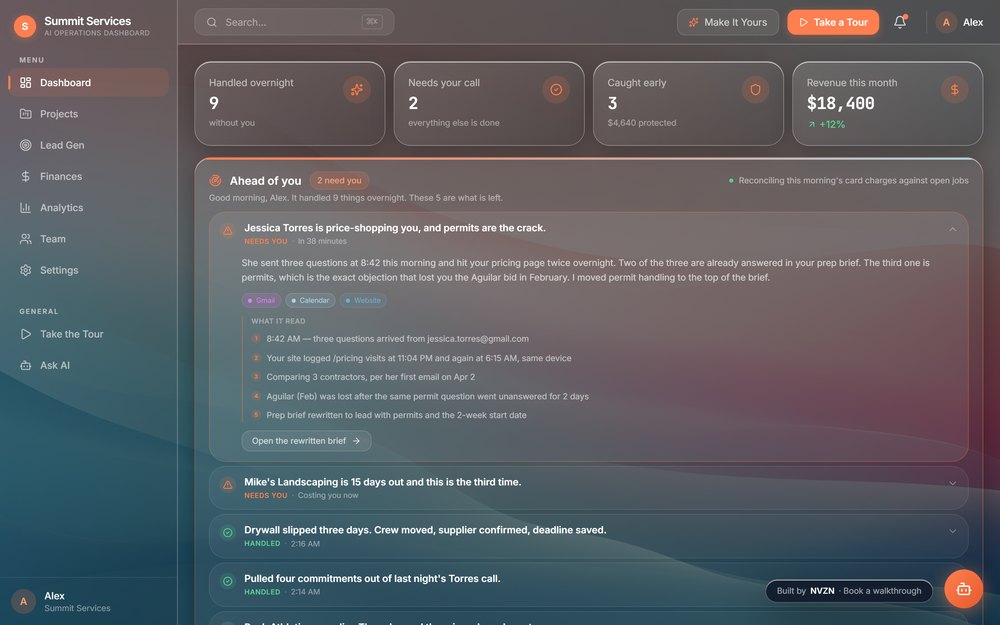
The public NVZN demo, running on a fictional company. Screenshot: AI Business.
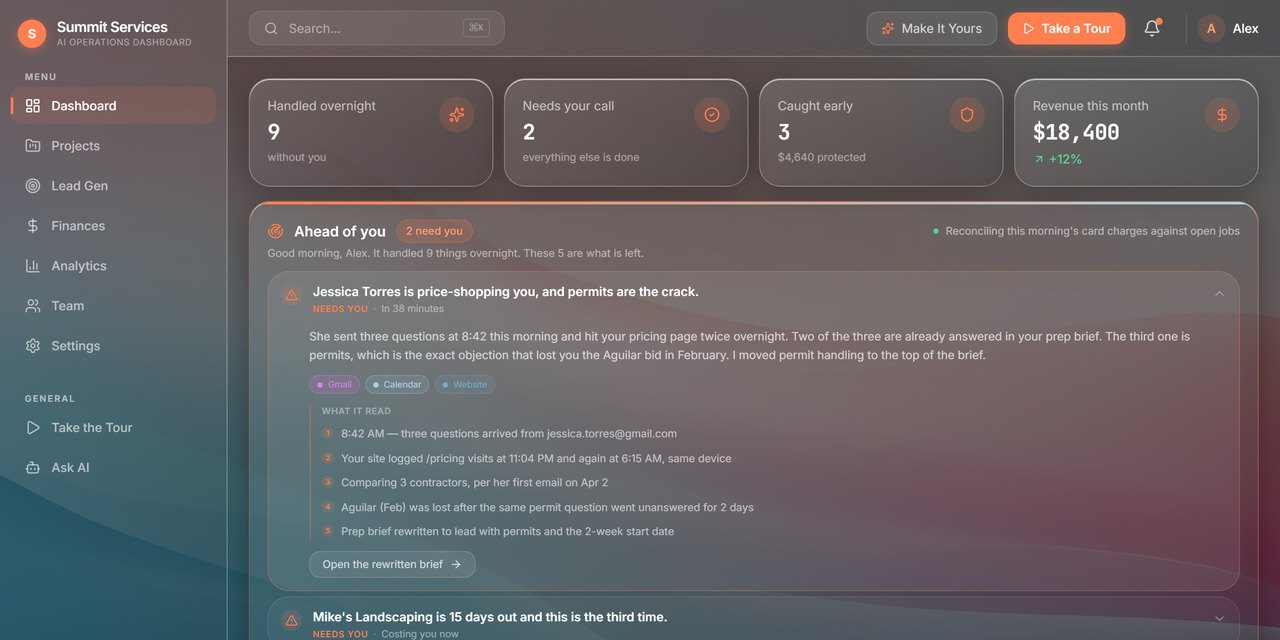
The top row is not a chart. It is a count of what happened without the owner, what still needs them, and what was caught early. Below it sits the part that makes the argument: a client who is price-shopping, with the evidence laid out underneath. Three questions arrived at 8:42. The pricing page was visited twice overnight from the same device. The same permit objection lost a bid in February. The prep brief has been rewritten to lead with permits.
That is the design philosophy made visible. The system is not answering the client. It is assembling the case and handing it to the owner with 38 minutes to spare.
The boundary that does not move
Trujillo draws a hard line, and it is the most commercially interesting thing in her answers.
"We force a human boundary on client-facing messages and judgment calls. Autonomy without trust is not innovation. Ops AI for the messy middle is."
This is a deliberate rejection of the fully autonomous agent pitch. Her view is that unsupervised outbound does not remove work from a small business, it relocates the risk to the person who can least afford it.
"If your outbound is fully automated on day one, you are not being innovative. You are gambling with trust."
The second rule is about the stack. NVZN does not ask a business to adopt a new set of tools.
"We do not invent a new stack for people who already resent their logins. We use what they have. We train on how their shop actually works."
Why this is a money question, not a productivity one
The comparison NVZN is really competing against is not another piece of software. It is a hire.
For a shop of five to fifteen people, the first operations or admin hire is the largest new fixed cost the owner will take on, and it arrives before the revenue that justifies it. Trujillo's argument is that the hire often fails for a reason nobody budgets for.
"I love great people. I also know what happens when you hire into chaos. You clone the bottleneck."
Her framing is a first department delivered as a system rather than a premature headcount: the status hunting, the chasing and the re-entering handled underneath, so that when a person is eventually hired, they arrive into something that already works and can spend their time on judgment.
Pricing is not published. The company sells through a discovery call, and offers a twenty-minute ops audit that maps where work piles up and whether the next step should be a system or a person.
The lesson: competence became a trap
Asked what building this taught her, Trujillo answers with something more uncomfortable than a product insight.
"I stayed too long in seasons where I was useful to everyone else's chaos and unclear on what I wanted to build. Competence became a trap. People pulled me in to clean up operations, and I said yes because I could, not because it was the business I meant to own."
The fix was a plain question about what she was actually good at and would still enjoy in five years. The answer was operations, structure, making chaos make sense, and NVZN came out of that.
"Usefulness without ownership is a slow leak."
The operational version of the same lesson is one any team automating a process should probably write on the wall: map the real workflow before you automate it, and define what done means before you build anything to do it.
Traction, in her own terms
NVZN is a year old, and Trujillo is candid that she is not going to perform numbers.
The product is live and the dashboard can be clicked through without an account. She describes a small team, steady clients and recurring work, and names operators willing to stand behind it publicly, including Kip Gilleland of TLS Land Services and Cleo Lewis. Testimonials from both appear on the company's site. She has been featured in VoyageDenver and CanvasRebel.
"I prefer qualitative traction over theater numbers, but the shape of year one is real shipped product, paid operator work, and owners who feel pressure leave their shoulders when the system holds."
What is next
More of the same, deliberately. Deeper product for the one to fifteen band, tighter loops from the first conversation to a live dashboard, and better fidelity to each shop's own procedures.
"Same rule set: systems over theater, humans on trust-critical work, Denver-built and operator-led."
The NVZN demo is at demo.nvzn.ai, and the company is at nvzn.ai.
---
This is a Partner Story: a written interview with a company building with AI, submitted through Submit Your Story and published free of charge. Statements about the company's product, customers and results are its own. Building something with AI? Tell us about it.
Would you try this product?