Let me ask you something honestly: when you imagine starting a "robot business," what's stopping you? For most people it's the same wall, it feels expensive, technical, and reserved for engineers with venture funding. I want to take that wall down, because there's a side door almost nobody is talking about, and it costs about as much as a decent laptop.
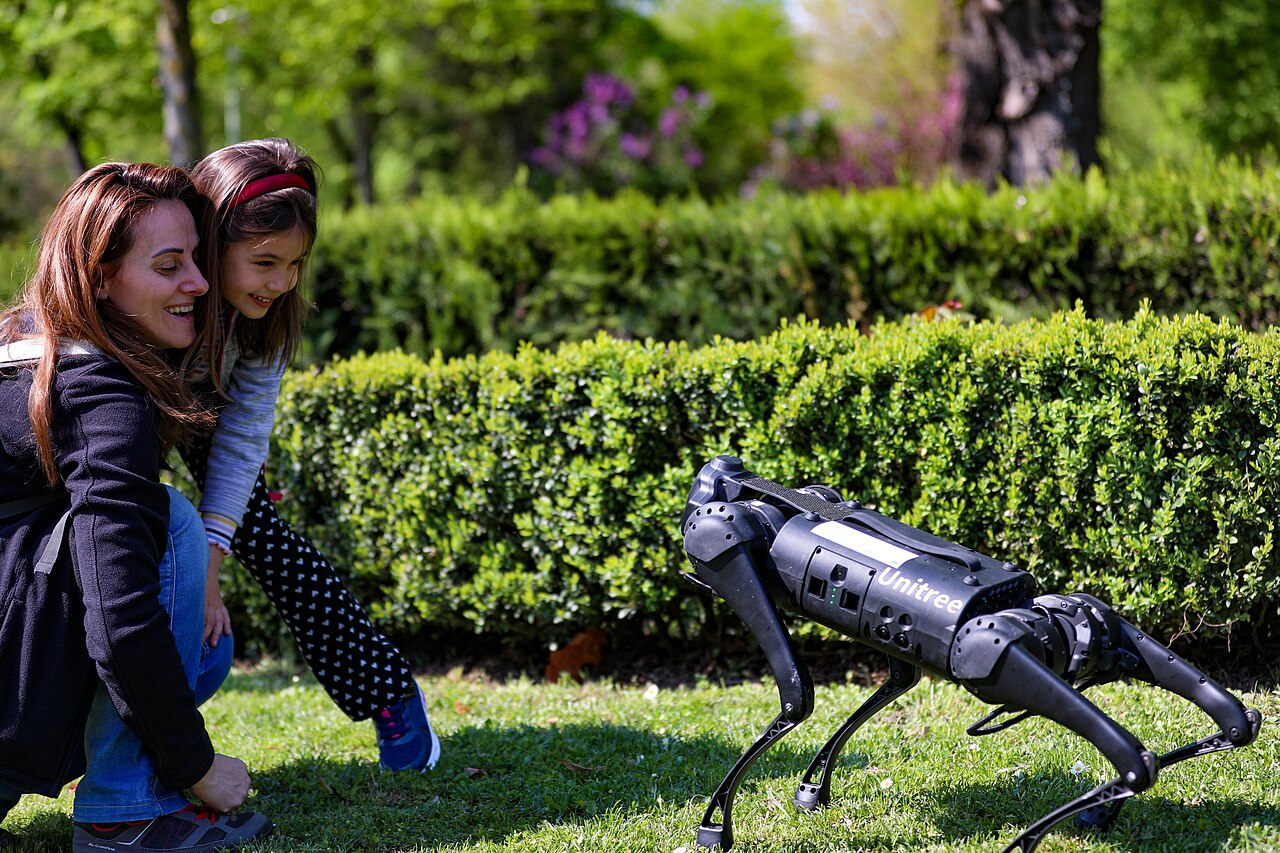
It's the robot dog. And no, I don't mean a toy. I mean a real, four-legged, LiDAR-equipped, terrain-climbing quadruped robot, the kind you've seen patrolling, dancing, and hauling gear in viral videos, that a Chinese company called Unitree will now sell you starting around $1,600. That's not a typo. While the world argues about $30,000 humanoids that don't ship yet, the cheapest practical robot you can actually buy and put to work is sitting in stock right now, and it walks on four legs.
If you've been watching robot clips rack up engagement and quietly wondering whether there's a business in here for a normal person, there is, and the robot dog is the most accessible on-ramp that exists today. Let me walk you through it warmly and honestly, the good and the annoying parts both.
The price collapse nobody noticed
Here's the context that makes this remarkable. The famous robot dog, Boston Dynamics' Spot, costs $75,000 and up. For years, that was the price of admission to the quadruped world, which meant only big utilities, oil companies, and research labs could play. The robot dog was a corporate tool, not a personal asset.
Then Unitree did to robot dogs what it later did to humanoids: it collapsed the price. The Unitree Go2 starts at roughly $1,600 for the Air model, around $2,800 for the Pro, with a developer-focused EDU version near $3,790 and a heavier-duty Go2 Enterprise around $8,900. Even the top configurations stay a fraction of Spot's price. One widely-quoted comparison put the Go2 at 96% cheaper than Spot, faster and lighter too, though it trades away Spot's industrial ruggedness and certified autonomy.
That price gap isn't a small discount. It's the difference between "only a Fortune 500 can own one" and "a freelancer can buy one this month." And Unitree isn't a fringe player, it holds over 60% of the global quadruped robot market share. When you buy a Go2, you're buying from the company that already dominates the category, not a sketchy knockoff.
Why does it cost so little? The same reason every Chinese robot is cheap: China controls the motors, the actuators, the batteries, and the rare-earth magnets, and prices them at roughly a third of Western cost. The robot dog is simply the smallest, cheapest expression of that supply-chain advantage, which means it's the easiest one for you to get your hands on.
What this little machine can actually do
Before we talk money, you need to believe the robot is genuinely capable, because a cheap toy is worthless and a cheap tool is a business. The Go2 is a tool.
It carries Unitree's self-developed 4D LiDAR, giving it 360-degree spatial awareness with a blind spot small enough to detect obstacles as close as five centimeters. Through large-scale AI simulation training, it has learned advanced movement, climbing stairs and obstacles, rolling back onto its feet when it falls, even walking upside-down in demos. It sees, it balances, it navigates, and on the developer models it runs an onboard Nvidia Jetson computer you can program for autonomous tasks.
In plain language: this thing can walk a defined route by itself, carry a camera or sensor, map a space in 3D, and stream back what it sees. That's not a gimmick. That's the core of several real services people pay for. And here's the AI connection that makes it belong on this site, the reason the Go2 can do any of this is the same wave of AI perception and reasoning that powers everything else we cover. The legs are old technology. The brain that lets it understand a messy environment is brand new, and it's the same brain reshaping the whole economy.
How people actually turn a robot dog into income
Now the part you came for. A $1,600 robot is only smart if it earns more than $1,600. Here are the real ways people are doing exactly that, pick the one that fits who you are.
Inspection-as-a-service. This is the clearest money-maker. Construction sites, solar farms, warehouses, factories, and utilities all need regular visual inspection, checking equipment, tracking progress, spotting problems, and sending a human into hot, high, or hazardous spots is slow and dangerous. A robot dog with a camera walks a fixed route, captures consistent footage, and never needs a safety harness. Companies already pay handsomely for Spot to do this at $75,000; you can offer a leaner version with a Go2 at a fraction of the cost. Charge per inspection or per monthly retainer, and a single recurring client can cover your hardware in a month or two.
3D mapping and surveying. That onboard LiDAR isn't decoration. The Go2 can scan and map indoor and outdoor spaces in three dimensions, useful for construction documentation, real estate, facility management, and "digital twin" models that businesses increasingly want. Surveying and scanning services bill real money per project, and a robot that walks the site while you direct it turns a multi-hour manual job into a supervised stroll.
Security patrols. A robot that autonomously walks a defined perimeter at night, streaming video and flagging anything unusual, is a genuine product. Warehouses, lots, events, and properties all need after-hours presence, and a patrolling robot dog is both effective and, frankly, a deterrent that makes people stop and stare. You can run this as a service or rent the robot to a security company for their overnight shifts.
Content, events, and marketing. You already noticed robot videos get absurd engagement, that's a business, not just a vanity metric. A robot dog at a product launch, a mall opening, a trade-show booth, a wedding, or a music video is a crowd magnet that people film and share for free. Creators monetize robot content directly through views and sponsorships; event companies rent the spectacle by the day. You bought a $1,600 asset; now it earns a day rate and markets itself in everyone's phone footage.
STEM education and workshops. Schools, universities, and coding camps are desperate for hands-on robotics that isn't a $75,000 commitment. The EDU model, with its full SDK and open-source community, is built exactly for this. Running robotics workshops, school demos, or a small course around a Go2 is a real income stream, and it compounds, every workshop builds your reputation as the local "robot person," which feeds every other path on this list.
The honest downsides (because I'd rather you succeed)
I'm not going to sell you a fantasy. A cheap robot is a cheap robot, and you should know the catch before you spend.
The Go2 lacks Spot's ruggedness, payload capacity, and certified industrial-grade autonomy, so for mission-critical, heavy-duty, or safety-regulated environments, the expensive robot still wins, and you shouldn't oversell what yours can do. Battery life is limited, so real deployments mean managing charge and swaps. Support and repairs trace back to China, which means you are the front-line service when something breaks, budget time and a little money for it. And like any robot working near people, there are safety and liability questions you need to take seriously, not wave away.
None of that kills the opportunity. It just shapes it. The smart move is to match the robot to the right jobs, light inspection, mapping, patrol, content, education, and be honest with clients about where it shines and where it doesn't. Under-promise, let the working robot over-deliver, and your reputation does the selling.
Why the robot dog is the right first move
Here's why I keep coming back to the quadruped instead of the flashy humanoid. The humanoid is the headline, but it's expensive, often unavailable, and harder to deploy usefully today. The robot dog is cheap, in stock, genuinely capable, and already proven in real commercial jobs. It's the lowest-risk way to actually start, to learn how to source, operate, program, and sell a robot, on a machine that costs less than a used motorcycle.
And the timing is the whole point. Right now, almost nobody in your city is offering robot-dog inspection, mapping, or patrol services, because the technology still feels exotic and the suppliers are unfamiliar Chinese names. That unfamiliarity is your moat. By the time a Go2 feels as normal as a drone, the market will be crowded and the easy clients taken, exactly the way early drone operators cleaned up before everyone owned one. The person who buys their first robot dog this year, learns it cold, and lands three recurring inspection clients will be impossible to catch in 2028.
You don't need $75,000. You don't need an engineering degree. You need $1,600, a willingness to look a little crazy for a few months, and the nerve to walk into a construction office and say, "Let me show you what my robot can do." The cheapest robot in the business is also the easiest place to start one. That's a rare combination, and it won't last.
---
Keep Reading
- How to Make Money Importing Chinese Robots Before Everyone Else, the full reseller, integrator, and rental playbook
- China Is Putting $16,000 Robots on Factory Floors, the bigger boom your robot dog is the doorway into
- How to Make Money with AI Agents in 2026, the software-only version of this side-hustle playbook
- The One-Person Company: Run a Real Business Solo, how a robot service fits a one-person operation
- The Highest-Paying AI Jobs of 2026, what these robot skills are worth on the market